Energy Catalyst Round 11 awards funding to high-impact clean energy innovations
London, UK – June 23, 2026
Energy Catalyst has announced the winners of Round 11 funding, supporting high-impact clean energy innovations across Africa, Asia and Latin America, with over £6m available in catalytic grants.
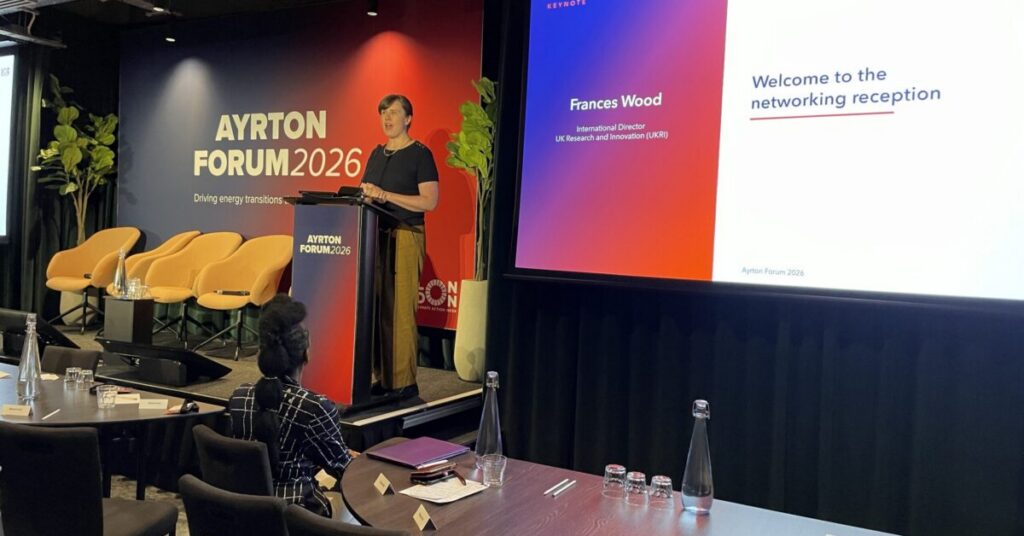
The winners of Energy Catalyst Round 11 were announced yesterday evening, marking the latest round of UK support for clean energy innovation. The announcement was made by UKRI’s International Director, Frances Wood, at the Ayrton Forum 2026, which convened policymakers, innovators, investors and delivery partners from across the clean energy ecosystem as part of London Climate Action Week.
This latest round of funding builds on Energy Catalyst’s ongoing investment in innovative solutions that expand access to affordable, reliable and clean energy in underserved markets. By supporting the development, testing and scaling of new technologies and business models, the programme helps improve energy access while creating opportunities for UK businesses to strengthen their global competitiveness, forge new commercial partnerships and drive economic growth. Delivered through the Ayrton Fund and funded by the Department for Science, Innovation and Technology (DSIT), Round 11 reflects the UK Government’s continued commitment to accelerating the research, development and demonstration of the innovations needed to achieve sustainable energy access for all.
Jilian Henderson, Innovation Lead at Innovate UK commented – “This funding will help grow innovative projects that bring reliable, clean energy to communities that need it most, supporting better healthcare, education and livelihoods. Through Energy Catalyst, we’re helping turn ideas into practical solutions that improve lives and support a fairer, more sustainable energy future.”
A diverse portfolio of solutions
A total of 10 projects have been selected across 11 countries in Africa, Asia and Latin America, spanning early, mid and late-stage development, including:
Early Stage
RE5 (UK), Brunel University London (UK) and SAMA^Verte: CAER (Pakistan) – a model improving the resilience of rice supply chains in Pakistan by helping food companies support clean, affordable energy access for rice-growing communities. The project will test solutions including a mobile solar DC unit for water pumping, filtration, phone charging and other essential services in weak-grid and off-grid areas.
University of Exeter, ERAC Energy Limited: Time-Responsive, Inclusive, and Appliance-Level Guaranteed Energy Services: ‘TRIAGE’ (Zambia) – a new method of delivering electricity in Zambia through enabling households and community institutions to pay for guaranteed appliance service time, such as lighting, phone charging or refrigeration, rather than kilowatt-hours. The project uses ERAC Energy’s Flexiload device to prioritise energy for the most important appliances and improve affordability, reliability and inclusion.
Investingreen, Universidad Santo Tomas – Seccional Villavicencio, SPEAL SAS: BioPower_PIG (Colombia) – a decentralised, modular system in Colombia that turns pig farming waste into reliable electricity at farm level. The model integrates anaerobic digestion, biogas purification and energy generation, combined with an Energy-as-a-Service model to lower upfront costs and improve access for small and medium-sized producers.
Mid Stage
Eco Research, Northumbria University, Prime Eurotech, University of Kamalia: SAFER Plus (Pakistan) –
a system that converts agricultural waste into engineered bio-coal, wood vinegar, surplus heat and electricity. The project addresses both seasonal crop burning and energy poverty, while building a women-led supply chain to collect feedstock and create local employment.
Pluto Manufacturing, Hive Composites, and Fuel Flex: Digitally monitored composite pipeline system for reliable clean energy transport (South Africa) – a digital quality assurance and monitoring system for thermoplastic composite pipelines. The project aims to make it safer, faster and more affordable to deploy pipelines for hydrogen, ammonia and CO2 transport, while supporting local skills transfer and cleaner energy infrastructure.
ELECTROGENOS Ltd, Geotérmica para el Desarrollo S.A.P.I. de C.V. (GEODESA): GeoH2-Flex (Mexico) –Investigating whether geothermal energy can be coupled with a high-efficiency electrolyser to reduce the cost of green hydrogen production in Mexico. The project will test whether waste heat and flexible operating modes can improve efficiency and make green hydrogen competitive with fossil fuel alternatives.
Late Stage
Mobile Power (MOPO), University of Sheffield: MOPO Duo, MOPO Plus, MOPO Grid (Nigeria, Liberia, Democratic Republic of the Congo, Sierra Leon) – Supports the commercialisation of next-generation battery technologies for home, business and electric mobility use across sub-Saharan Africa. The project aims to reduce the cost of clean energy access through smart battery architecture and field trials of sodium-ion batteries, helping communities move away from petrol generators.
PILIO, Sociedade Algodoeira do Niassa JFS, SA (JFS): Ace Cotton (Mozambique) – The ACE Cotton programme expands clean energy access and strengthens biodiverse farming practices in cotton-growing communities. The project will unlock microfinance and entrepreneurship for solar technologies that support productive use, reduce emissions and build resilience.
I-Renewable Energy, WANA Energy Solutions, LENDAHAND ETHEX, Amped Innovation: EasyFreeze (Uganda) – Deploys a new generation of solar-powered cold-chain technology in Uganda to help rural entrepreneurs store and freeze perishable goods. The project combines high-performance refrigeration, thermal storage, PAYGO financing and local repair capacity to improve incomes, reduce spoilage and cut emissions.
AED Energy, Central Energy Corporation: Replacing coal-fired industrial heat in South African mining using thermal energy storage (South Africa) – The pilot is designed to provide reliable, lower-carbon heat for industrial operations and create a replicable model for other heat-intensive sectors.
The projects highlighted above show the breadth of innovation being supported through Round 11 that are commercially relevant, locally grounded and capable of delivering cleaner, more reliable and more affordable energy where it is needed most.
Backing innovation to deliver a just energy transition
Energy Catalyst supports the development and scaling of innovations that respond directly to critical energy challenges and realities, helping communities access more reliable power, enabling new income-generating opportunities, and reducing exposure to polluting and costly energy sources. Since its launch, the programme has awarded over £162 million to 336 projects across 48 countries, demonstrating the role targeted innovation funding can play in accelerating progress toward a more inclusive energy transition.