Powering transport: clean energy on the roads that connect communities to opportunity
This is Part 2 of our series Powering Essential Services: Clean Energy Solutions Transforming Daily Life in Underserved Communities.
Economic opportunity often depends on whether goods, riders and services can move freely. Transport determines whether farmers can reach markets before produce spoils, whether traders can move goods affordably, whether riders can earn a living, and whether rural communities can connect to services and income beyond their local communities.
Across sub-Saharan Africa, many of the transport networks that perform that work run on fossil fuels. In many rural areas, they are also sparse, expensive or unreliable. On some rural roads, motorcycle taxis now provide around 80 per cent or more of passenger and goods transport. For commercial riders, fuel can consume a large share of daily takings, binding livelihoods to a commodity where prices are volatile and can fluctuate sharply. In cases where motorised transport is unavailable or unaffordable, livelihood opportunities shrink, goods move slowly by bicycle or on foot, post-harvest losses mount, and small producers remain cut off from the markets where their products could command fair prices.
E-mobility offers an alternative, but cleaner transport depends on freight networks that can reach underserved areas, vehicles that riders and logistics operators can afford, charging and swapping infrastructure that fits daily working patterns, and batteries that can be manufactured, maintained and reused locally. In cities, electric vehicles can already be cheaper to run than petrol equivalents, but high upfront costs and limited finance still hold back adoption.
Energy Catalyst, an Innovate UK programme supporting clean energy innovation in underserved markets, is backing companies that are treating transport as a vital part of the energy access challenge. Three projects, spanning electric freight in Rwanda, automated battery swapping in Uganda, and circular battery manufacturing designed to sustain the transition, show what clean energy transport looks like on the ground.
Electric freight on hard-to-serve roads
Rwanda’s road network spans over 15,000 kilometres, much of it unpaved and mountainous. For many rural communities, conventional trucking is unaffordable, and motorised freight remains out of reach.
Numa Logistics, formerly OX Rwanda, has been supported through Energy Catalyst since Round 9 which commenced in 2023. Energy Catalyst funding helped the company establish charging infrastructure at four grid-connected sites in Rwanda, now supporting the largest all-electric commercial vehicle fleet in the country. The fleet serves customers from smallholder loads to long-distance haulage, and the charging network has begun serving third-party vehicles as demand for electric vehicle charging grows across Rwanda.
Electricity costs per kilometre are three to five times cheaper than diesel. Since launching its pilot operation in 2021, Numa has served over 7,600 customers in Rwanda, 50 per cent of whom are repeat users. Using grid electricity rather than diesel strengthens the emissions case, particularly as Rwanda expands renewable generation. The result is not just a cleaner truck, but a freight model that can make market access more affordable on roads conventional logistics has struggled to serve.
Electric boda bodas in Kampala
In Kampala, an estimated 350,000 boda boda motorcycle taxis serve a city of three million people with no mass transit system. For riders whose motorcycles are their livelihood, income depends on how many trips they can make and how little they spend on fuel. Replacing those machines with cleaner, cheaper alternatives requires more than a better engine; it requires an energy ecosystem priced at a level riders can sustain.
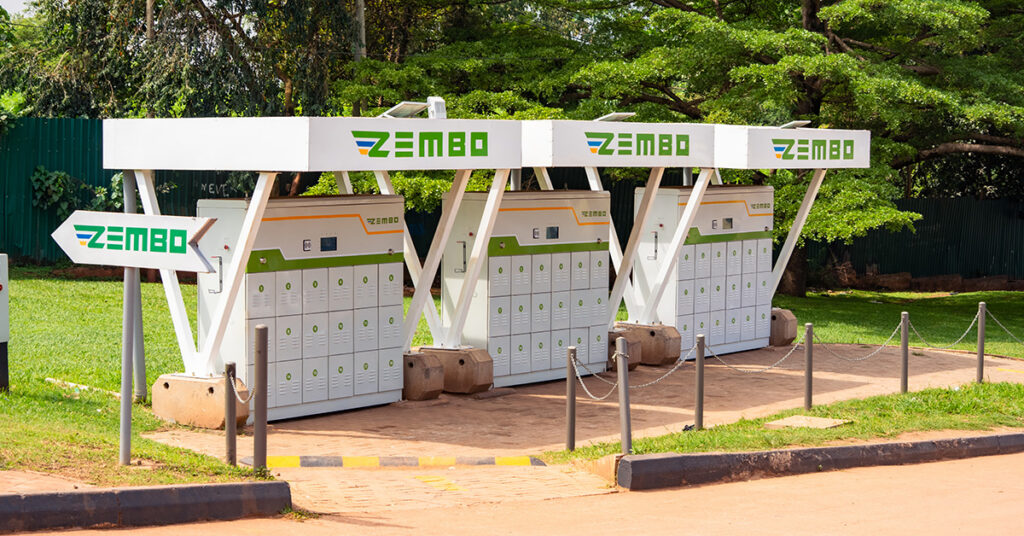
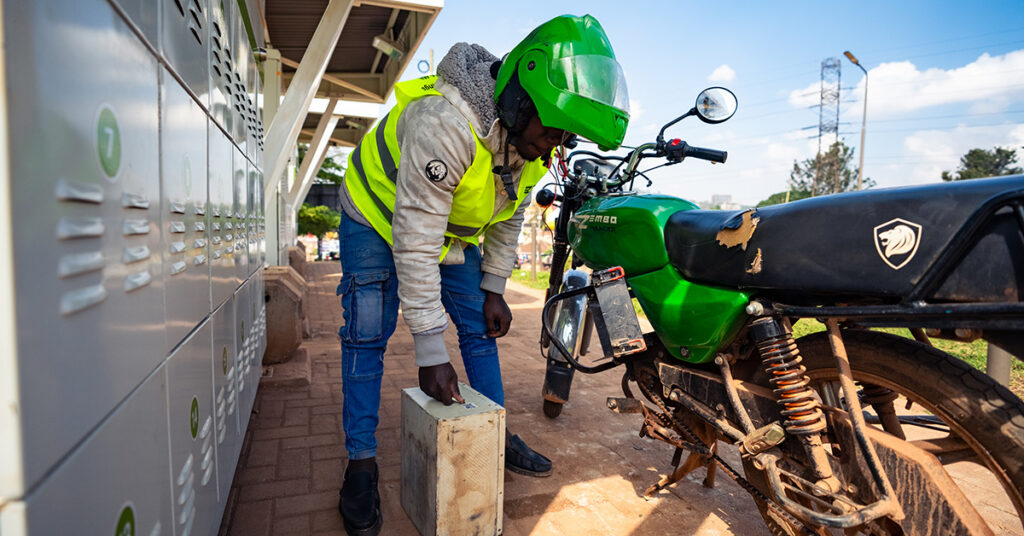
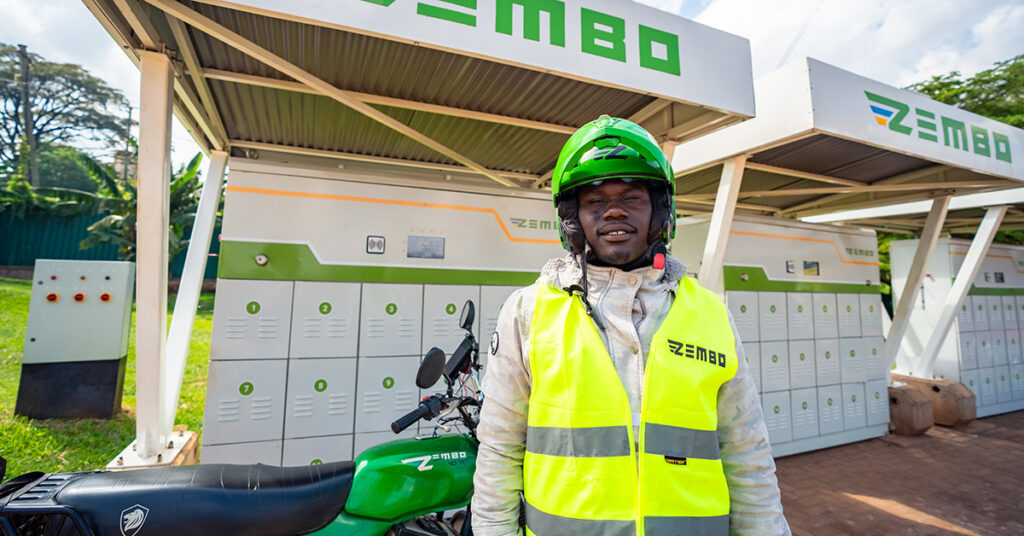
The ion Ventures and Zembo partnership, supported through Energy Catalyst Round 10, (which commenced in 2024) is developing Uganda’s first automatic battery swapping cabinet network for electric motorcycles. Zembo already provides locally assembled electric motorcycles to boda boda drivers on a rent-to-own basis, with battery swaps available at 30 stations using solar, hybrid and grid-connected charging, drawing on Uganda’s hydro-heavy electricity system. The EC-funded project is building 30 automatic self-service battery cabinet stations across the network.
The first automated station, launched in September 2025 at a TotalEnergies service station in Nakawa, can serve over 100 riders per day. Riders using Zembo’s electric motorcycles save up to 50 per cent on daily energy costs compared to petrol. For drivers whose earnings depend on uptime, fast battery swaps turn clean energy into working time.
A second life for electric vehicle batteries
As electric motorcycles scale across East Africa, the battery becomes more than a vehicle component. It becomes a future storage asset, a waste risk, and a local manufacturing opportunity.
Lithium-ion batteries are removed from electric vehicle service once they deplete to around 80 per cent of their original capacity, but they retain significant value for stationary applications such as off-grid solar storage and backup power. Without a system to capture that value, spent EV batteries become e-waste. With one, they become affordable energy storage for communities that cannot yet pay for new lithium-ion systems.
Soleil Power, supported through Energy Catalyst Round 10 in partnership with STI4D, describes itself as East Africa’s first diversified lithium battery manufacturer, producing both new and second-life packs within a single facility in Uganda. The EC-funded project, completed in March 2026, designed three EV battery products, two for two-wheeled vehicles and one for an electric tractor, and produced 55 prototype and pilot packs. It has led directly to commercial orders from Zembo, which values procuring batteries domestically and having an offtake partner for end-of-life packs.
Soleil has processed approximately 22,000 second-life cells to date, producing around 200 packs serving 20 customers. A 12.8V 100Ah second-life pack retails at approximately $185 compared to $365 for the first-life equivalent. The company’s experience has also revealed a structural challenge: at early volumes, testing, grading and quality assurance can make second-life packs more expensive to produce than new batteries at the same facility. As electric motorcycle fleets across Uganda grow, so will the supply of cells and the volumes needed to bring second-life costs down. The second-life packs store solar energy for off-grid use, extending the productive life of both the battery and the renewable electricity it carries.
From demonstration to system change
As urbanisation accelerates and fuel costs rise, demand for affordable, clean transport across the continent will only grow. The African Union’s Continental Framework on Electric Mobility, endorsed by African transport and energy ministers in 2026, points towards domestic vehicle assembly, charging infrastructure and battery ecosystem development. Energy Catalyst’s transport projects show how those priorities become practical: charging depots for electric freight on unpaved roads, automated swap cabinets for Kampala’s boda boda riders, and local battery manufacturing that can turn e-mobility’s future waste stream into affordable storage.
“Clean energy transport does not have to wait for paved roads, grid infrastructure, or conventional vehicle financing to reach the people who need it,” says Andra Stancu, Programme Manager, Energy Catalyst. “These exciting projects show that the technology and the business models exist, and our role is to help prove they work, so that governments and investors can back them at scale.”
Read Part 1: Powering healthcare | Part 3: Powering education (coming soon)