Smart Villages Research Group: powering rural livelihoods through locally-led Smart Agri-Centres
Smart Villages Research Group (SVRG) is a UK-based company spun out of Oxford and Cambridge-based research on energy access and sustainable rural development. Since 2012, SVRG has worked globally to translate research into practical energy-for-development solutions, including pilots Eastern and Southern Africa and Southeast Asia.
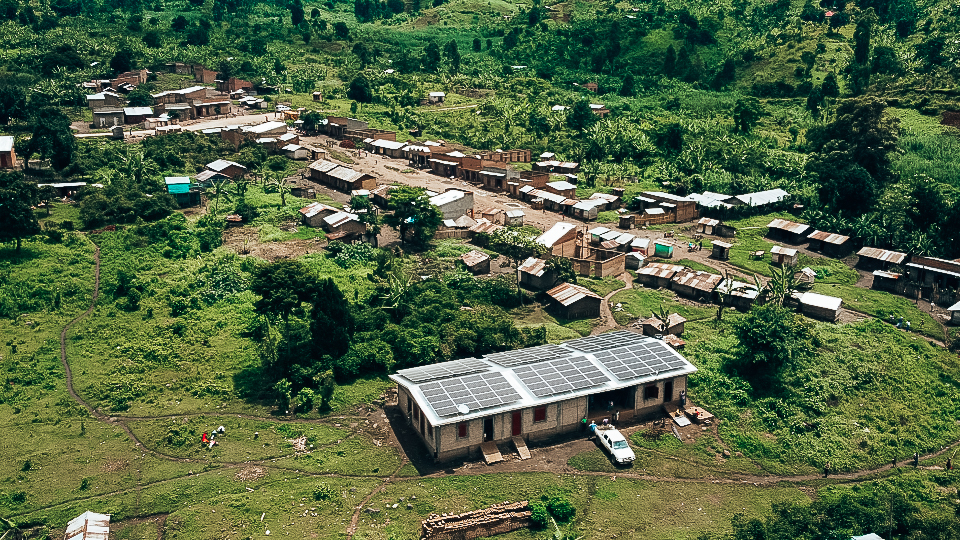
The Smart Agri-Centre (SAC) model represents SVRG’s latest innovation: solar-powered community hubs that integrate renewable energy, agricultural processing, cold storage, training and enterprise support. Each site includes around 50 kW of solar generation and productive-use equipment tailored to local value chains, with governance structures embedded in existing cooperatives or NGOs. SVRG developed the SAC concept alongside their in-country partners: Kiima Foods, a Ugandan anti-poverty NGO, and Foundation Rural Energy Services (FRES), a Dutch not-for-profit advancing rural electrification in rural Africa.
With four centres now operating and six more in planning across Uganda, SVRG is testing distinct technical and financial configurations to identify scalable, community-owned business models. To explore this locally-led approach, Energy Catalyst interviewed Laura Allerston, Commercial Director, and Bernie Jones, Managing Director at SVRG.
Q1. Were SVRG active in Uganda before your first Energy Catalyst project, and what motivated you to develop Smart Agri-Centres?
Our work in Uganda builds on more than a decade of research and field experience across East Africa and globally. Before our first Energy Catalyst-supported project in Uganda in 2020, we had run small pilots in Tanzania and Uganda, testing how off-grid technologies like solar-powered cold storage and mini-grids could meet community needs. In 2019, we implemented a low-cost cold room pilot in Uganda under the Efficiency for Access R&D Fund, using locally manufactured materials and labour to reduce costs and build skills. Those lessons around trust-building, flexible governance and co-design shaped what became the SAC model.
The challenge we saw was clear: although Uganda’s generation capacity has increased, rural electrification remains below 10 percent. Many farming communities depend on diesel generators or have no reliable power, limiting productivity, increasing post-harvest losses and constraining incomes.
We realised energy access couldn’t be treated as an end in itself: it needed to be tied directly to agricultural value creation. SACs were therefore designed as solar-powered hubs offering affordable energy and productive use equipment such as appliances for cooling, drying and milling. Each centre supports smallholders to process, store and market their produce locally.
Q2. Why test different productive-use models at each site, and how did you ensure each SAC reflected local needs?
No two communities are the same. Our four operational SACs in Uganda have been designed to test different productive use and business models: dairy cooling and maize milling; cassava and groundnut processing; horticulture and irrigation; and training facilities for refugee farmers.
Through focus groups and service value tests (a participatory methodology to understand and test service needs directly with end-users), communities identified their key priorities before technical design began. We worked with cooperatives, NGOs and women’s groups to tailor equipment and governance for each centre. This stems from our “Smart Village” methodology: treating communities as co-researchers and viewing each site as a collaborative experiment in innovation, rather than applying a standardised blueprint. biomass technologies allows us to create a closed-loop system that maximises resource utilisation, minimises waste, and creates affordable energy for farmers and rural communities.
Q3. How did you build trust with communities, and why is local engagement integral to sustainability?
Partnerships are central to our methodology. We invest heavily in early engagement, which involves community mapping, focus groups and clear discussions on roles and expectations. Local organisations such as Rural Family Care in Kasese and dairy cooperatives in Mbarara act as anchor partners, embedding SACs within trusted social structures.
Trust came through consistent presence and follow through. We returned repeatedly to share updates and invite feedback. As a result, community members felt genuine ownership. Two SACs are now fully community-managed, with SVRG providing only technical backstopping, while others remain under joint management as capacity builds.
Local engagement also underpins long-term viability. Embedding SACs within existing cooperatives or NGOs reduces dependency on external actors and strengthens institutional capacity. We facilitate separate sessions for women and youth to ensure inclusive decision-making and encourage their representation on boards. Women constitute around 40% of board and business committee members across SAC sites. Training in finance, governance and maintenance further strengthens resilience.
At Mbata, our first SAC site in Western Uganda, 91% of farmers visit several times a week, so the SAC has become a genuine community hub. The site brings together a wide range of income-driving services, including cold and dry storage, aggregation, milling and processing, welding, an agro-input shop, training facilities, internet access, and value-addition services like juice processing and salon operations.
Q4. What results have you seen at your Mbata site, and what do they tell you about the model’s potential?
The results for our first operationalised SAC site at Mbata after one year exceeded expectations. Our field test surveyed 93 local farmers and tracked changes in income, costs, yields and behaviour.
Economically, the gains were substantial. Farm revenues increased 171% and profits 283%, effectively quadrupling earnings. This came from both higher revenues and reduced costs: operating costs fell 30% as farmers no longer paid for frequent transport and could access quality inputs locally.
Average yields increased 32% despite adverse weather. Post-harvest losses dropped sharply for crops using cold storage and losses for cauliflower and passionfruit were almost eliminated. For high-volume crops like potatoes and cassava, yields rose dramatically; initial losses increased as farmers adjusted storage practices, but these are expected to decline as experience grows. Rising yields were also driven by training on improved agronomic practices.
Social impacts were also strong. 92% of farmers said the SAC positively affected their children, whether through skills gained or the ability to afford school fees. All farmers reported increased income and savings. Many described developing a more “business-oriented mindset”: planning ahead, experimenting with crops and taking productive risks.
New opportunities emerged through services such as welding, milling, juice processing, salon operations and agro-input retail. Training attendance was nearly universal, covering financial management, governance, post-harvest handling and climate-smart farming.
Crucially for the long-term promise of this model, resilience improved. When coffee and banana crops failed in both Mbata and a neighbouring community, Mbata farmers adapted quickly by shifting crops and sustaining performance. Access to storage, processing and training strengthened their ability to recover from shocks.
Q5. How did Energy Catalyst support strengthen your monitoring and evaluation approach?
Energy Catalyst project funding enabled us to deploy several SACs, test and refine different business model and technical configurations, and deepen engagement with local communities. The hands-on support also strengthened our ability to track outcomes across SAC operators, enterprises, individual users and wider communities.
Working closely with Energy Catalyst, we refined our sampling approach, control group design and KPIs across sites. Indicators now cover income, productivity, enterprise creation, jobs, gender participation and environmental benefits, providing credible evidence for investors and policymakers while helping us improve performance. Crucially, the combination of quantitative data and qualitative stories – farmers describing how their children learn new skills or how they’ve gained confidence – reveals pathways to impact that metrics alone might miss.
Q6. What financing challenges did you face, and what pathways have emerged?
Financing productive use assets is difficult where formal credit is limited. Cooperatives pay modest service fees for milling, cooling or processing, generating income for operating costs and maintenance. We are testing cooperative contributions, revenue-sharing, micro-leasing and revolving funds.
The Mbata results demonstrate strong potential for financial viability. Revenues are already substantial enough that the centre is on track to repay roughly US $250,000 in infrastructure costs in under two years. That suggests locally managed facilities can move towards bankability when embedded in productive value chains, crucial for attracting private capital and scaling beyond grants.
We are exploring blended finance and carbon credit aggregation to unlock scale while keeping services affordable, structuring finance around actual revenue-generating capacity rather than repayment schedules that don’t match agricultural cash flows.
Q7. What lessons have you learned from implementing the SAC model?
Flexibility is essential. Each community requires different governance and financial structures. Strong local ownership, transparent revenue sharing and early maintenance planning are critical.
Behavioural change takes time and visible benefits. Farmers used to selling immediately at the roadside need to see the value of aggregation and processing. The Mbata data shows this shift: farmers developing business-oriented thinking, confidence to experiment and willingness to invest in education because the SAC reduces uncertainty.
Resilience emerges as a core benefit. Access to storage, processing, training and markets gives farmers confidence to take productive risks and recover from shocks. Each SAC functions as both commercial venture and learning laboratory. We are not imposing standardised solutions, we are co-creating context-appropriate models that communities can own and evolve.
Q8. How do you see the SAC model scaling in Uganda and beyond?
We are finalising designs for four additional sites while strengthening partnerships in Uganda. Early results from Mbata give us confidence to replicate the model across East and Southern Africa, with Uganda as a demonstration hub.
Core elements are transferable: modular solar, productive-use integration, participatory design and robust monitoring. Governance, finance and equipment adapt to context; what works for dairy cooperatives in Mbarara differs from what refugee farming communities in Lira need.
Collaboration with ministries, rural electrification agencies and financial institutions will be essential for transitioning pilots into nationally recognised models. We are also exploring aggregation of impact across multiple SACs for carbon credit generation and blended finance. Individual sites can become locally sustainable, but accessing larger climate and development finance requires a portfolio-level approach.
As a finalist for the Milken–Motsepe Prize in Green Energy, our model has been recognised for significantly increasing farmer incomes. Over the next three years, we aim to establish a network across Uganda and begin replication in neighbouring countries. Ultimately, we want SACs to enable communities to lead their own energy transitions, linking clean power with inclusive agricultural growth and wider rural transformation.